


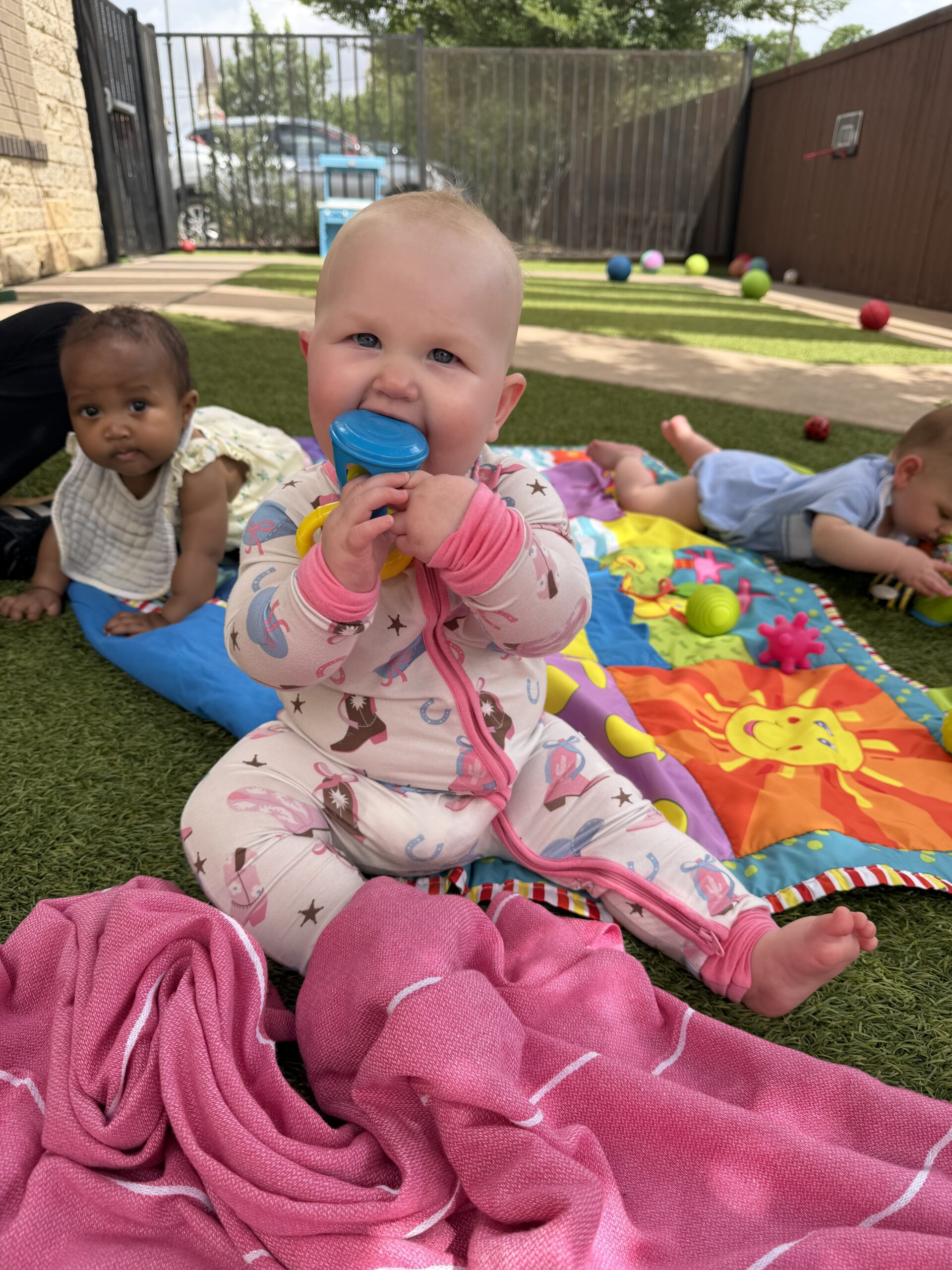
INFANTS

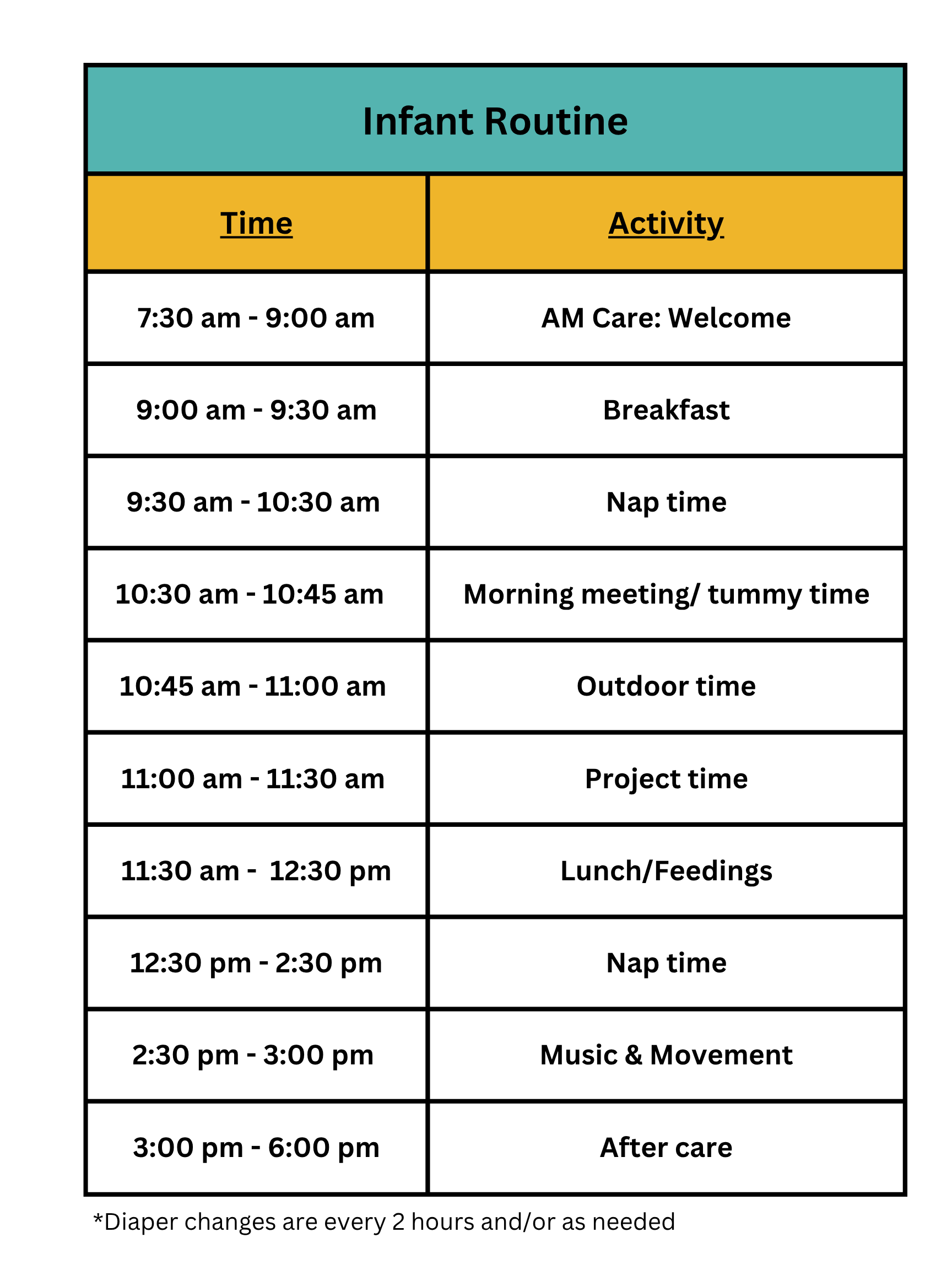
Infant Program Schedule

Ages: 3 months – 18 months

Our Infant Program provides a nurturing and caring environment designed to support early development and individual attention.

  • Capacity per classroom: 10 infants
  • Staff per classroom: 3 teachers
  • Schedule: Monday – Friday
  • Program: Full Day (9:00 a.m – 3:00 p.m)
  • Extended Care: Available (7:30 a.m – 6:00 p.m)
1. Does my infant have to stay all day? Can I pick him/her up early if my schedule allows it?

No, your infant does not have to stay for the full day. While we strongly recommend maintaining a consistent daily routine—especially for infants, as it supports their sense of security and development—we also understand that every family’s schedule is different.

Our Infant Program offers care from 7:30 AM to 6:00 PM, and you are welcome to pick up your child at any time that is convenient for you within these hours.

2. What requirements do you have for your teachers?

Lead teachers for infant and toddler classrooms must have a bachelor’s degree or CDA (Child Development Associate) degree. Lead teachers for preschool classrooms must have a bachelor’s degree. Teacher assistants must have either a college degree or high school diploma. All teachers and teacher assistants are native Spanish speakers. Teachers must pass state and federal background checks as well as be trained in CPR every two years.  

3. Where are your teachers from?

SWS teachers and staff come from all parts of Latin America, including Mexico, Colombia, Puerto Rico, Cuba, Dominican Republic, Peru, Venezuela, El Salvador, Honduras, as well as from the United States and Spain. 

4. How do teachers communicate with parents?

SWS uses the Brightwheel application for communication with parents. You will receive daily reports from teachers as well as pictures and updates throughout the day. Administration will also use the Brightwheel application, as well as emails, to communicate pertinent information. We also hold Parent/Teacher conferences in the Fall and Spring.  

5. What do parents need to provide each day?

Parents provide snacks, lunch and all necessary supplies, including diapers, wipes and extra clothes. Infant classrooms have refrigerators to store milk, as well as milk warmers. We are not able to microwave food and encourage parents to pack hot food in thermos containers. Parents are also responsible for sending water bottles, which will be re-filled throughout the day.

6. What is your nap policy?

When infants first join our program, they often arrive with individual sleep routines established at home. Our teachers work closely with families throughout the school year to gradually transition all infants to a consistent classroom schedule, typically by the middle of the year.

Infants generally begin with up to three naps per day: a morning nap, a midday nap, and an afternoon nap as needed.

Spanish World School provides each child with an individual crib and fitted crib sheets. For safety reasons, only pacifiers are permitted in cribs. Blankets, toys, and other personal items may not be placed in the crib.

7. Can parents send sleep sacks for infants?

Yes, as long as the infant’s arms are free to move outside the sleep sack.  

8. How does the school handle student food allergies?

Parents are responsible for letting the administration know of any food allergies. Signs will be displayed outside of classrooms alerting teachers and visitors of any food allergies. Teachers will closely monitor students with food allergies during snack and lunch times. Students may store epi-pens in the front office. All food allergy information is shared with all classroom parents to ensure that any special treats provided by parents adhere to students’ individual needs. Any changes to students’ food allergies must be communicated with the school administration.  

9. Are vaccines required?

As a licensed daycare center, we follow the Department of Health and Human Services minimum standards, which include being up-to-date on state-required vaccines. Parents who choose a different vaccine schedule must provide a doctor’s note and notarized affidavit provided by the state.  

10. Do you follow each baby’s individual schedule?

Yes. We recognize that every infant has unique needs, so we follow individualized schedules for feeding, sleeping, and daily routines to ensure consistency between home and school. At the beginning of the school year, our teachers work closely with families to follow each child’s established schedule and routines.

As infants grow and develop, we gradually help them transition to a classroom routine that aligns with their peers. This process is individualized and occurs at each child’s own pace, helping create a smooth transition while supporting their developmental needs.

11. How do teachers comfort infants during separation?

Our teachers provide loving, responsive care to help infants feel safe, secure, and supported throughout the day. Consistency is especially important during the early months, which is why the same teachers greet and care for the children each day, helping them build trusting relationships and a sense of familiarity.

Parents are welcome to enter the classroom during drop-off to store bottles, milk, food, and personal belongings in their child’s designated spaces. Our teachers warmly welcome each infant in a playful and nurturing manner, helping create a positive start to the day.

During the adjustment period, teachers closely follow each child’s cues, offer comfort when needed, and maintain familiar routines. With time, consistency, and caring interactions, most infants become comfortable with their new environment, develop strong bonds with their teachers, and confidently adjust to the classroom setting.